Synthetic Audiences, Real Consequences: What We Learned at NYTechWeek
Panoplai hosted a panel discussion at Pianos NYC during NYTechWeek with practitioners who've built AI audience intelligence inside real companies — and hit the limits. Here's what they said.
Every company has a gap between what customers say and what they actually do. That's not a new problem. But for the first time, we have tools that can close it — or, if we're not careful, make it invisible.
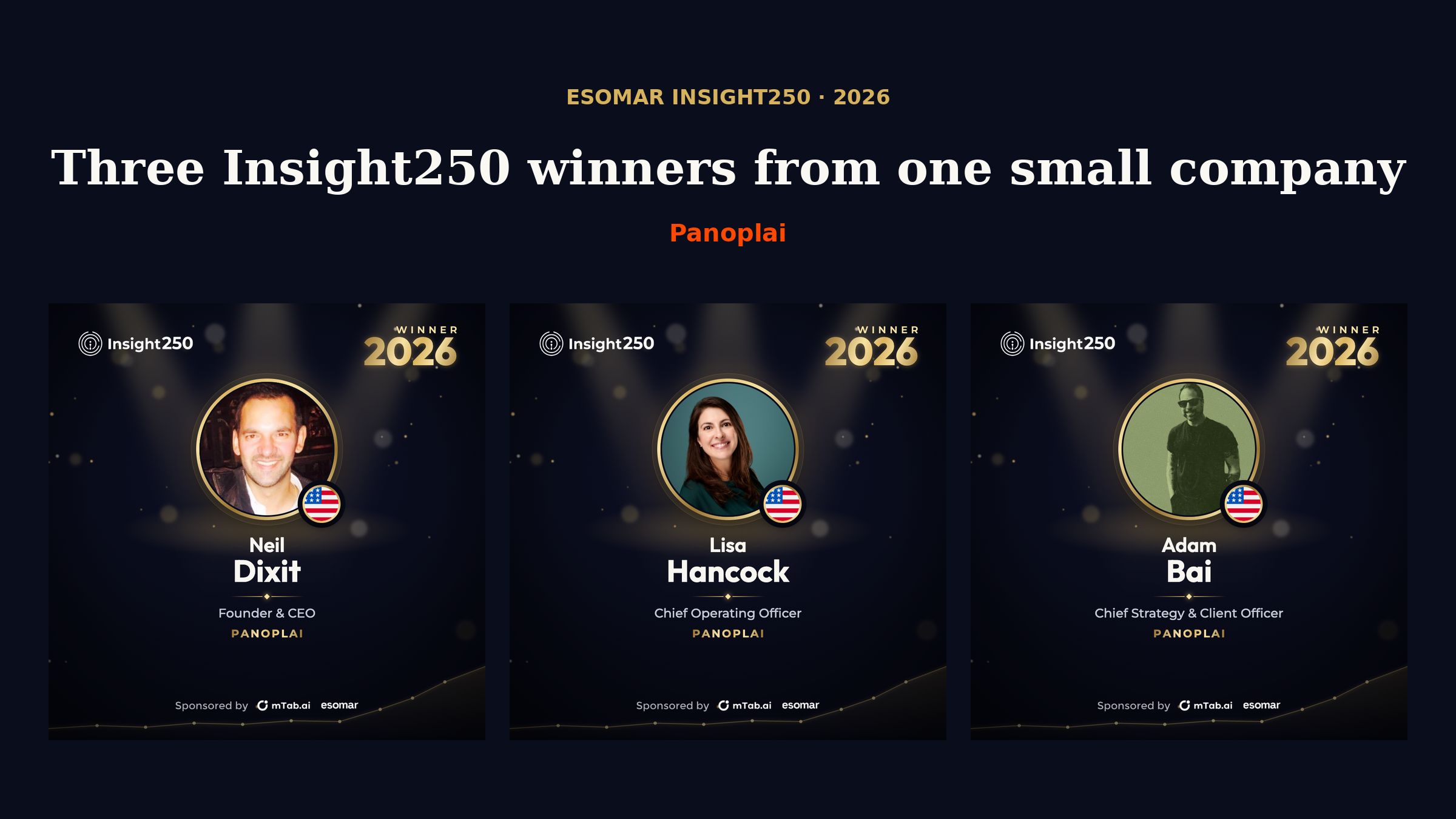
That tension was at the heart of our NYTechWeek panel, Synthetic Audiences, Real Consequences, held June 2 at Pianos NYC. Moderated by Josh Ingram of Most Wanted Co., the conversation brought together Neil Dixit, founder of Panoplai, and Phil Ahad, Managing Director at Cint, for an honest hour on what synthetic data and digital twins actually deliver — and where they fall dangerously short.
Here are the five things that stuck.
1. Most "AI personas" on the market are vaporware
The pitch sounds irresistible: synthetic consumer personas, built in minutes, from a handful of prompts. Many vendors are selling exactly that. The panel was direct: this is the most dangerous corner of the hype cycle.
AI personas constructed with minimal real data through consumer LLMs can feel convincing while being systematically wrong. They reflect the model's training biases more than your actual audience. The outputs are confident. The conclusions are false. And because they look like research, they get used like research.
The distinction that matters: indication versus validation. Consumer AI tools are useful for directional, exploratory thinking — quick pulse checks, hypothesis generation, early-stage framing. They are not suited for high-confidence decisions or large-scale ingestion. That requires statistical rigor, methodological discipline, and enterprise-grade infrastructure designed to handle millions of responses with the appropriate care.
2. The industry is at an inflection point — and ignoring it is not an option
Market research has a relevancy problem. Surveys are long, expensive, and slow. Decision-makers have started bypassing the research function entirely, turning to gut instinct or unstructured AI outputs because they're faster. That's a more dangerous outcome than imperfect synthetic data.
The promise of AI isn't to replace the discipline of research — it's to make it viable again. Engage real people briefly. Ask fewer, better questions. Then augment with synthetic and linked data to complete the picture. Done right, you reduce respondent burden and increase the frequency at which research can influence decisions, not just validate them after the fact.
3. Digital twins and synthetic data are not the same thing
These terms get conflated constantly, and the confusion is doing real damage to how teams evaluate and deploy both.
Synthetic data is about creation and enrichment — generating statistically valid data that can fill gaps, stress-test models, or scale what you've collected.
Digital twins are interaction layers. They let you build a model of a specific audience segment — say, females 21–49 in California who drink wine — and then interact with that model. Ask it questions. Test concepts and campaigns. Simulate behaviors based on data-backed representations of real people.
The practical implication: digital twins are most powerful when they sit on top of rich, ongoing data collection. They're not a shortcut around real data. They're how you get more out of the real data you already have.
4. Real data comes first. Always.
This was the panel's most consistent through-line, and it bears repeating clearly.
Synthetic augmentation is powerful — but it requires a foundation. For fast-changing contexts (politics, live macro events, breaking cultural moments), human data remains essential and irreplaceable. Synthetic models can't predict what they haven't been trained on.
A growing pattern in the market is what the panelists called "seeding": data-scarce startups running small surveys — sometimes as few as 10 questions — to seed synthetic models, then returning repeatedly to field for more. It works in the short term. It's not a sustainable strategy.
The correct sequence: collect foundational real data first. Ground your model. Then augment with synthetic sources to enrich, scale, and extend — not to substitute for the foundation you skipped.
5. Trust is earned through validation, not assumed
Every new methodology in research faces a trust gap. Synthetic data is no different. The answer isn't to assert that it works — it's to prove it.
The validation framework that matters: parallel testing. Run synthetic models alongside human-collected data and compare the outputs. Measure accuracy against stated versus actual behavior. Define your benchmarks before you start, not after. And be honest that human data is not the gold standard it's sometimes treated as — it has its own biases, its own limitations, its own ways of being wrong.
The teams making synthetic data work aren't the ones with the most sophisticated models. They're the ones with the most disciplined validation process.
The bottom line
Synthetic audiences and digital twins are not magic. They are tools — powerful ones, with specific use cases, real limitations, and meaningful consequences when misapplied.
Used well, they close the gap between what your customers say and what they actually do. They make research faster without making it less rigorous. They let you ask more questions of the data you already have.
Used poorly, they make that gap invisible. They produce confident outputs that feel like insights and aren't. And they give decision-makers exactly enough false certainty to make expensive mistakes.
The practitioners who are getting this right are not the ones moving fastest. They're the ones who started with real data, validated ruthlessly, and scaled only what they could prove.
That's what we're building at Panoplai. And it's the conversation we'll keep having.
Want to continue the conversation? Schedule a meeting with our team or follow us on LinkedIn for more on synthetic data, digital twins, and the future of market research.

.png)
%20(200%20x%20108%20px).png)