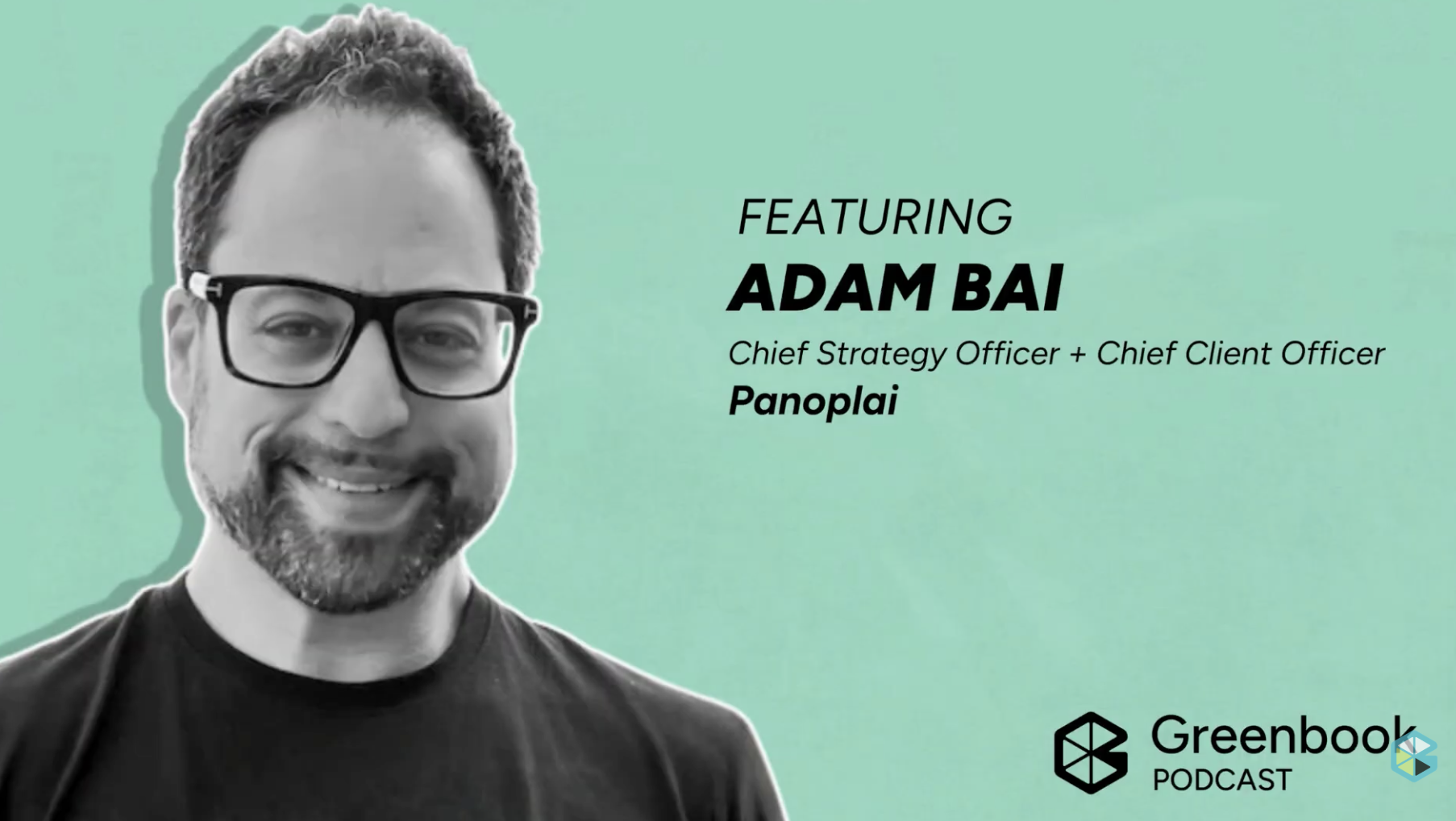
Panoplai's Chief Strategy & Client Officer, Adam Bai, joined Karen Lynch on Episode 173 of the Greenbook Podcast — "Shaping the Future of Insights." It's a wide-ranging conversation about where the insights industry is headed, why Panoplai built what it built, and what it actually means to be "too early" in this space. Here are the highlights.
🎙️ Watch the full episode: Greenbook Podcast Ep. 173
A Milestone Worth Reflecting On
The conversation comes on the heels of Panoplai winning Greenbook's inaugural Industry Impact Award at IIEX North America — recognition for the company Greenbook believes best represents where insights is headed.
As Adam put it on the podcast, the award wasn't meaningful because of the prestige. It was meaningful because it validated the thing Panoplai has actually been trying to do: anticipate where the industry is going, build for the present and the future, and genuinely care about what insights professionals need to thrive in that future.
Panoplai's Chief of Staff, Kelsey Whitehead, called it the one she was happiest to win. Adam's take: "I felt seen — like listened to and seen by the industry. It was a big moment for me."
The Cost — and the Discipline — of Being Early
Three and a half years ago, Panoplai was building enterprise digital twins and synthetic data pipelines. At the time, almost nobody was asking for that. Early adopters showed up for pilots; most brands said some version of "interesting — I'll keep an eye on it."
Today, everyone wants to try digital twins.
Adam's lesson from that gap isn't "don't be early." It's the opposite — being early is how you build something real. The actual lesson: structure your business around the fact that you're early. That means staying honest about where revenue comes from today versus where it'll come from in 18 months, and not betting the whole company on a market that isn't ready yet — while still building toward it.
Panoplai kept the digital-twin talk track and kept building the feature set, while also getting disciplined about the fundamentals of running an insights business. The result, in Adam's words, is a more complete platform than the company would have built if it had only chased the vision.
The Shift From Order-Takers to Question-Shepherds
The through-line of the episode is a bet on what insights professionals become next.
Adam's view: the most valuable skill for an insights professional five years from now won't be knowing how to run a survey or stand up a digital twin. It'll be knowing when to stop the machine. As AI-driven workflows get faster and more automated, the platforms that win won't be the ones that make everything seamless — they'll be the ones that inject friction strategically, on behalf of a professional who can pause and ask whether the automation is answering the right question in the first place.
That reframes the job. Historically, insights teams answered the questions they were handed. Adam wants the next generation empowered to question whether leadership is asking the right questions at all — to be, in his words, "the shepherds of the right questions." None of that works, he argues, without an underlying commitment to human data and to the judgment only insights professionals bring.
It's the same instinct behind a story Adam's been telling about an early AI experiment: a boat-racing game where researchers found an AI had learned to torch its own boat and circle for points instead of crossing the finish line — technically optimal, completely wrong. It's a useful check on where AI in insights could go if nobody's asking whether the destination still makes sense.
Predicting the Present, Not the Future
Adam closed with a reframe of strategic foresight worth sitting with:
"Strategic foresight isn't the ability to predict the future. It's almost the opposite — it's predicting the present by seeing signals that are still a little bit quiet, then understanding which ones will scale and shape behavior. The future's already here. It's just unevenly distributed."
That's the operating premise behind Panoplai's platform, and it's the thread running through the whole conversation: don't try to guess what's coming — get better at noticing what's already quietly here.
🎙️ Full conversation: Adam Bai on the Greenbook Podcast with Karen Lynch, Episode 173 → Watch here

.png)

%20(200%20x%20108%20px).png)