By Adam Bai
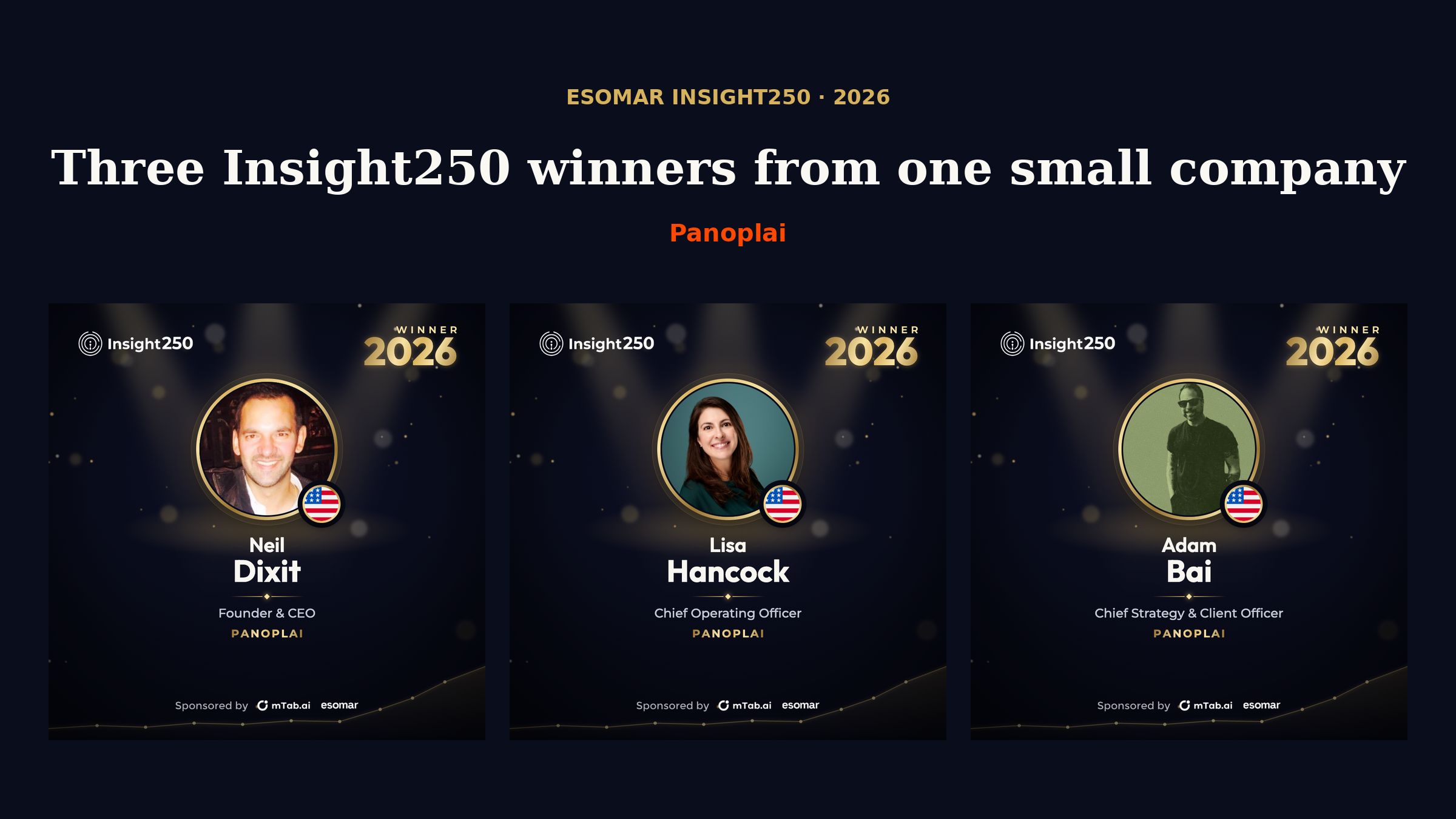
On Tuesday, ESOMAR announced the 2026 Insight250, its annual list of 250 leaders and innovators in market research, analytics and evidence-based marketing, presented with mTab. Three of us from Panoplai are on it: Neil Dixit, our founder and CEO; Lisa Hancock, our COO; and me.
It's the sixth year of the list. An independent jury of more than 50 insights, marketing and research professionals picks the winners from thousands of nominations worldwide, and the 2026 class spans more than 50 countries. (Lisa's Slack message when the names came up was "We are all winners!" Neil's reply, thirty seconds later: "Wait for real?!" That was roughly my reaction too.)
I'm proud of the recognition. But the part I find more interesting is what it says about the industry right now.
Three names from one small company
Since the announcement, several people in the industry have said some version of the same thing to me: it's unusual for three people from one company to make the list in the same year, and more unusual when the company is a small one. The list is full of Unilever and L'Oréal and Kantar and Ipsos, as it should be.
And it comes in the same year that Panoplai won the Industry Impact Award at Greenbook's Insight Innovation Competition at IIEX North America, and was a Best Paper finalist at ESOMAR Congress in Valencia for "The Mars Digital Twin Report Card," a paper we wrote and presented with a client.
I think all of this recognition is partly because the people at Panoplai, Neil and Lisa especially, have spent their careers inside the insights industry and share a deep-rooted commitment to it: to its long history of trying to understand human beings, and to methodological transparency and rigor, quant and qual both. (My own trajectory was through the academic anthropology of technology and innovation.) Neil made a version of this point on stage at the Restecher Capital Markets Day in New York last week. We want to help transform this industry, not “disrupt” it from the outside.
The industry is in flux, and not only because of AI
Two things are happening at once.
The first is that the insights functions inside brands are being reorganized, sometimes combining with data analytics teams, sometimes becoming progressively embedded inside marketing and product teams. This isn't a hunch. Greenbook's GRIT data has tracked the number of corporate functions involved in insights processes rising from 3.4 at the start of the pandemic to at least 4 in every wave since, and the same data shows line-of-business executives increasingly choosing methodologies and partners themselves (83% of analytics professionals see executives as key influencers on those choices, versus 34% of researchers). Anyone who has sat in a corporate insights team meeting in the past two years has felt this. The work is spreading out. The budget often isn't.
The second is that solutions from outside the industry are proliferating, and a lot of them are, in effect, off-ramps from human data collection and from transparent methodology. We hear the same story again and again. A board member or a CMO gets introduced to a venture-backed platform at a dinner or a conference and tells the insights team to go check it out. Or a marketing team asks the insights team for the raw qual transcripts so they can build personas on their own. (Sometimes with a chatbot, over a weekend.) None of these people are acting in bad faith. They're responding to real pressure to move faster and spend less. Nevertheless the result is sometimes AI slop, opaque black boxes, and poor decisions.
One of the speakers at the Restecher event used the phrase "supply chain for decision grade evidence," and it stuck with several of us. Supply chains have provenance. They have quality checks at known points. They have intentionally engineered resiliency. They have someone who is accountable when a batch is bad.
That imperative doesn't go away in a world of agentic decision loops. If anything the question gets sharper: where, exactly, do we build in moments of friction on purpose, so that a trained human can gut-check what the agents are doing? Are they sub-optimizing for the wrong goal? Are the outputs distinctive to this brand, or are they a generalized category average, the research equivalent of AI slop? Who signed off on the data the agent is reasoning over, and when? Those are insights questions. They always have been.
Why we build the way we build
This is why we have spent our energy on enabling the transformation of research and insights processes rather than on replacing them. We offer multiple methodologies (human surveys, digital twins, synthetic enrichment, simulation) because the right one depends on the question and the stakes, and anyone selling you a single answer is selling you their business model. And because research should be seen as an unfolding process rather than a single study.
We built the pipes to ingest human data in its raw form, SPSS files and transcripts and all, because a twin grounded in a brand's own verified data is a different object from an AI persona grounded in nothing in particular. And we publish our validation work, including the misses, because the aspiration is to eliminate black boxes, not to become a nicer-looking one.
The point of all this is to help insights, marketing, and innovation professionals carry their judgment into a new set of tools. Not to route around them.
Human data is about to get more valuable, not less
At Restecher, more than one speaker made the argument that human data will matter more in an AI world, not less. We couldn't agree more, and the evidence outside our industry points the same way.
Epoch AI estimates the total effective stock of public human-generated text at roughly 300 trillion tokens, and projects that language models "will fully utilize this stock between 2026 and 2032, or even earlier if intensely overtrained." Ilya Sutskever put it more bluntly at NeurIPS in December 2024, as reported by The Verge: "we've achieved peak data and there'll be no more." There's only one internet. And for difficult or rapidly changing audiences, there may not be any useful data on the public internet at all. The best quality data is increasingly locked behind firewalls.
And when models are trained on their own output instead, the results are not pretty. A 2024 paper in Nature by Ilia Shumailov and colleagues found that training on model-generated content "causes irreversible defects in the resulting models, where tails of the original content distribution disappear." The authors' conclusion is one that should circulate across every insights function: data collected about genuine human interactions "will be increasingly valuable in the presence of content generated by LLMs."
Even the people whose business is human respondents (sample) see it this way. In commentary on the 2026 GRIT Insights Practice Report, Dynata's Janice Caston and Ellen Romer argue that in an AI era "participation quality becomes more consequential – not less – because any weakness upstream carries further." (Vendor commentary, yes, but it matches what the computer scientists are saying from the other direction.)
So: an emerging training-data crisis on one side, and an industry that has spent a century learning how to collect, clean, weight and interpret human data on the other. The tails of the distribution, the emerging trends, the weird, brand-specific stuff, are exactly what collapses first when humans leave the loop. They are also exactly what insights people have always been best at finding.
A request
If you're an insights professional trying to work out where you fit in this emerging era of agentic decision loops, or you've been handed a platform to "check out" and aren't sure what questions to ask it, or a vendor has assured you that they’re 95% accurate across every use case and that you no longer need human data, I'd like to hear about it. Seriously. Email me - adam@panoplai.com.

.png)
%20(200%20x%20108%20px).png)