Are Digital Twins the Right Tool Here? A 5-Step Decision Framework
Three questions I hear from research and insights teams constantly:
Can I use Digital Twins for everything? When should I stick with reliable-but-slow human data? And what’s the right balance between the two?
The fact that these questions keep coming up isn't a sign that teams don't trust AI. It's a sign that they're thinking about it seriously — which is exactly right. Because using any tool outside its appropriate context erodes trust in that tool fast. One bad call and the skeptics in your organization have the ammunition they need to slow adoption for years.
That's why we built a decision framework. Not to sell you on Digital Twins — but to help you make a defensible, repeatable call on when they're the right fit and when they're not.
Here's how it works.
The question isn't "are Digital Twins good." It's "are they right for this decision."
Digital Twins aren't valuable because they're fast. They're valuable when they're fit for the decision. That distinction matters enormously in practice. Speed is a feature, fit is the requirement.
The framework we've developed walks through five questions in sequence. Each one narrows the field. By the end, you're not guessing — you're following logic.
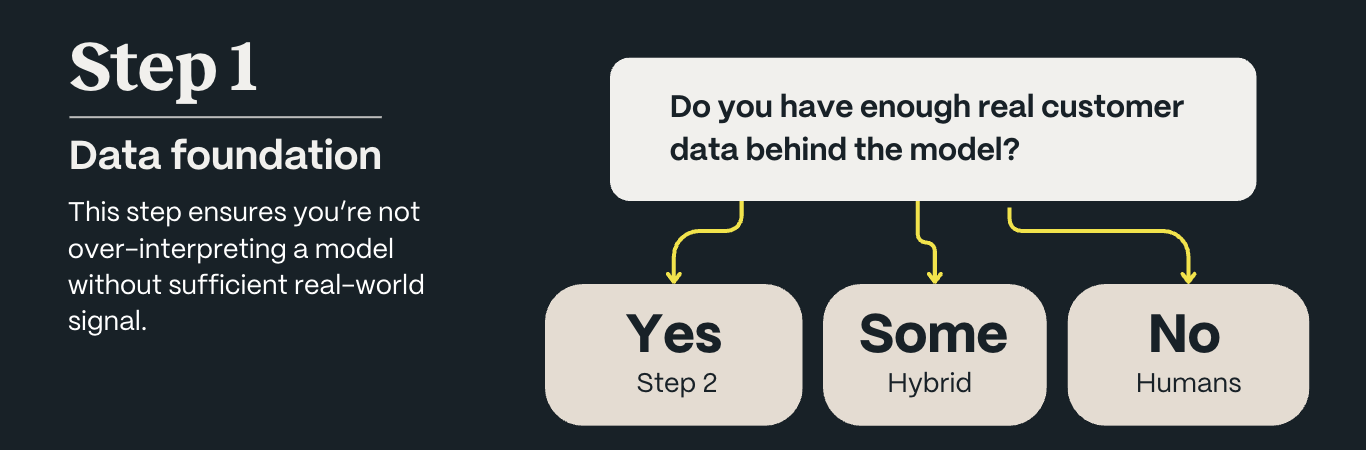
Step 1: Do you have enough real customer data behind the model?
This is the one teams most often want to skip. Don't.
A Digital Twin is only as good as the data it was built on. If your foundational dataset is thin, outdated, or unrepresentative of the audience you're trying to model, you're not getting insights — you're getting a confident-sounding reflection of your own assumptions. That's worse than no research at all, because it feels like validation.
If your answer is yes — you have solid, recent, representative data — move to Step 2. If it's some, consider a hybrid approach that supplements your Digital Twin outputs with targeted human research. If it's no, start with humans. There's no shortcut here.
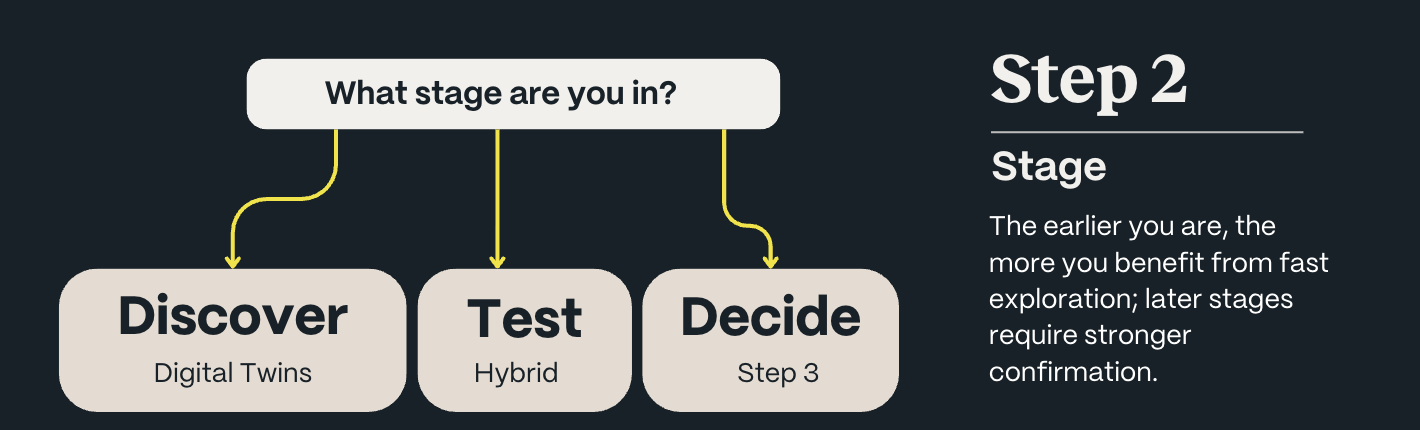
Step 2: What stage are you in?
Discovery, testing, or decision-making — these aren't just phases, they're different epistemological jobs.
In the discovery stage, you're exploring. You don't fully know what you're looking for yet. Digital Twins excel here because speed and breadth matter more than precision. You can run dozens of scenarios, surface patterns, and narrow your hypotheses quickly.
In the testing stage, it depends on risk, which is exactly what Step 3 addresses.
At the decision stage — where you're choosing a direction, committing budget, or going to market — Digital Twins should supplement human validation, not replace it. The earlier you are, the more you benefit from fast exploration. The later you are, the more you need confirmation.
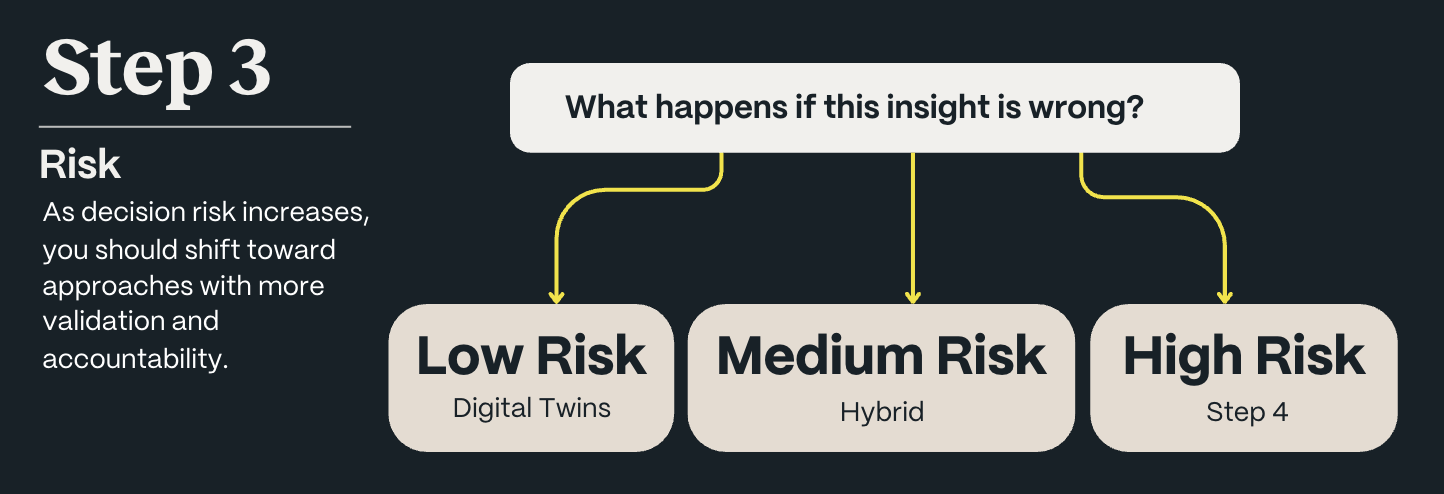
Step 3: What happens if this insight is wrong?
This is the most important question in the framework, and the one most teams underweight.
Low-risk decisions — early creative hypotheses, directional learning, initial concept screening — are exactly where Digital Twins shine. The cost of being wrong is low, the value of speed is high, and the alternative is often no research at all.
Medium-risk decisions — campaign refinement, concept optimization, prioritization — are where a hybrid approach earns its keep. Use Digital Twins to move fast and narrow the field, then validate the critical moments with human respondents.
High-risk decisions — national launches, pricing changes, regulatory submissions, irreversible calls — require human validation. Not because Digital Twins aren't accurate, but because the cost of error is catastrophic and human judgment is irreplaceable at the convergence point.
We tell our own clients this explicitly. An AI platform telling you when not to use AI might seem counterintuitive, but it's actually the only way to build lasting trust in the methodology.
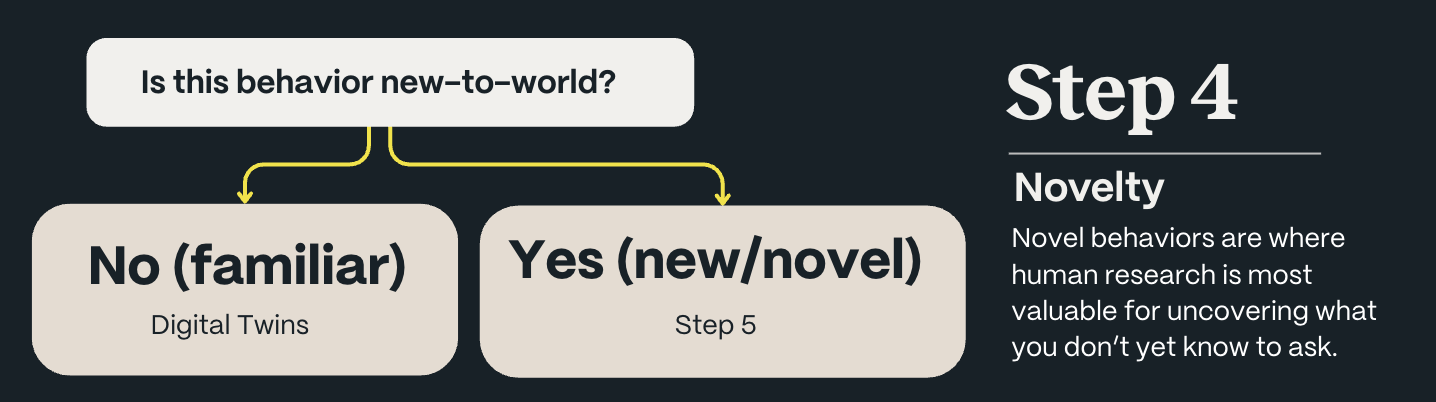
Step 4: Is this behavior new-to-world?
Digital Twins are trained on historical data. That's their power and their constraint.
If you're testing a concept that maps onto existing consumer behaviors — a new flavor, a repositioned brand, an optimized message — Digital Twins are on solid ground. They've seen this territory before.
If you're asking people to imagine and respond to something genuinely new — a behavior that doesn't exist yet, a category that's never been defined, a product that requires consumers to change how they live — human research is where you need to start. Novel behaviors are where human curiosity and probing are most valuable for uncovering what you don't yet know to ask. A Digital Twin can't tell you what it's never seen.
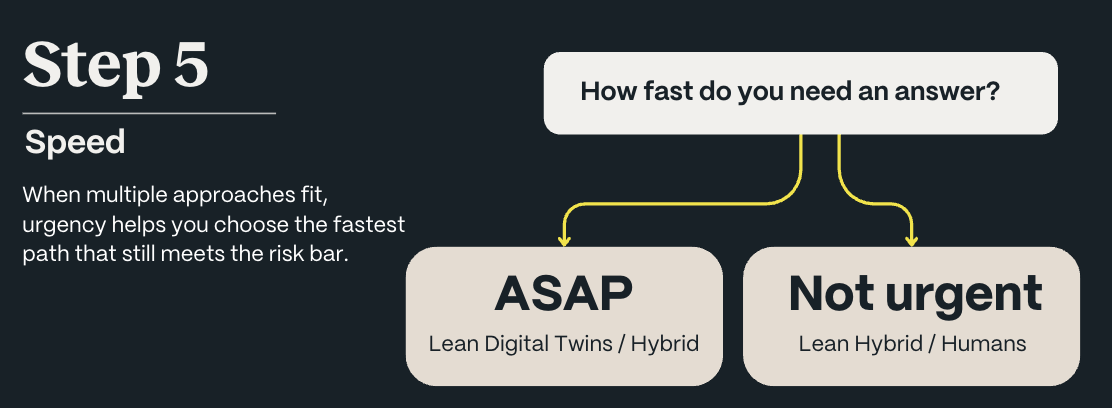
Step 5: How fast do you need an answer?
By the time you reach Step 5, you've already established that Digital Twins are appropriate for your data, stage, risk level, and behavior type. Now speed becomes the tiebreaker.
If you need an answer in hours or days, lean toward Digital Twins or a hybrid approach. If you're not under time pressure, lean toward hybrid or human research to maximize depth and confidence.
Speed doesn't determine validity. But it does determine feasibility. When multiple approaches are appropriate, urgency helps you choose the fastest path that still meets the risk bar.
The framework in one page
We turned these five questions into a decision tree you can run through in under a minute — and share with your team before the next methodology debate derails your kickoff.
The teams getting the most value from Digital Twins right now aren't the ones using them everywhere; They're the ones who've developed genuine clarity about where AI belongs in their workflow — and the confidence to say "not this time" when it doesn't.
That clarity is what this framework is designed to give you. Not a blanket yes or no on Digital Twins, but a repeatable way to make the call that you can defend to your stakeholders, your skeptics, and yourself.
Want to go deeper on the validation framework behind Panoplai's Digital Twin methodology? Read the full white paper at panoplai.com/trust-validation.

.png)

%20(200%20x%20108%20px).png)